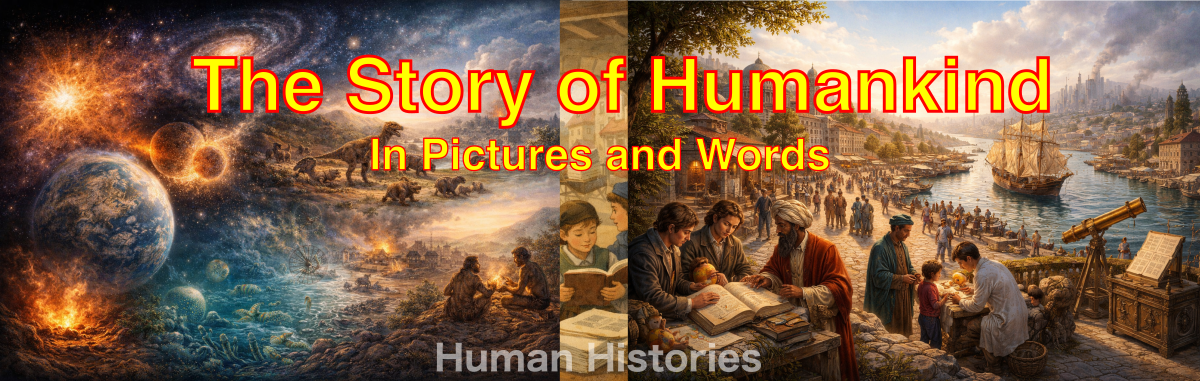
Why We Created The Story of Humankind — A Book for Readers from Age 3 to Adulthood
— A book that helps children and adults look at human history together
Introduction
Published in both Japanese and English, The Story of Humankind is a new kind of history book designed to be enjoyed by readers from age 3 to adulthood.
It can be experienced like a picture book, explored like a visual guide, and read as a thoughtful introduction to the story of humanity.
Why did we decide to create a book like this?
What ideas and design choices shaped it?
In this interview, we asked the author about the background of the project and the thinking behind the book.
Why Open “Human History” to Children?
Editorial Team: To begin, could you briefly explain what The Story of Humankind is?
Author: It is a book that traces the journey of humanity—where we came from, what kinds of events we have experienced, and how we arrived at the world we live in today—through pictures and words.
Rather than focusing on the history of a single country, it is structured to offer a broad view of humanity as a whole.
Editorial Team: What first inspired you to create this book?
Author: One major reason was the difference in how history is understood and taught. Historical education varies from country to country and region to region, and those differences can shape how people see the world.
That is natural in itself, but it can also become one reason why people find it difficult to understand one another.
That is why I felt there was value in creating a book that children could read from an early age and adults could return to later—a book that offers a shared point of reference.
The idea was to create a foundation for dialogue by helping people look at the same human story together.
What Does It Mean to Design a Book for Ages 3 to Adulthood?
Editorial Team: The target range—from age 3 to adulthood—is very broad. How did you design the book to work for such different readers?
Author: I tried not to force it into a single format.
Young children can engage with the illustrations and absorb the atmosphere visually.
Elementary school readers can read the text and deepen their understanding.
Adults can reflect on the larger flow of history and the meaning behind it.
By creating multiple entry points at once, the book allows different kinds of reading depending on the age and experience of the reader.
Editorial Team: It really feels both like a picture book and a visual reference book.
Author: Yes. It can be read from beginning to end, but readers can also start wherever their curiosity leads them.
I wanted it to be a book that invites conversation—something parents and children can look through together while asking, “Why did this happen?”
A Learning Experience Built into Reading Itself
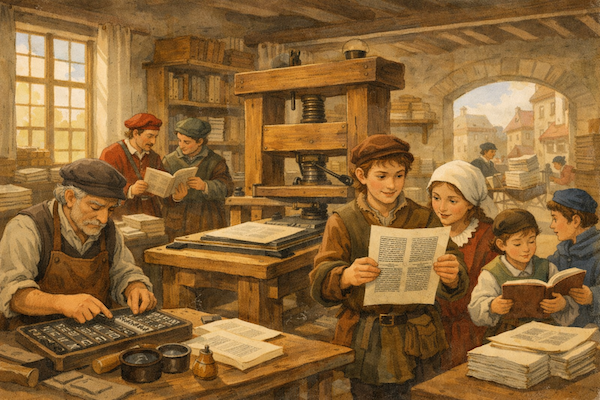
Editorial Team: In the Japanese edition, every part of the main text includes ruby characters for pronunciation. Could you tell us why?
Author: Yes. I wanted elementary school children to be able to read it on their own.
I wanted them to be able to move through the book at their own pace, without always needing an adult beside them.
Reading itself becomes part of the learning experience.
Children can naturally become familiar with the pronunciation of kanji while also deepening their understanding of the content.
At the same time, if everything were written only in hiragana, it would become harder for adults to read comfortably.
So by keeping appropriate kanji and adding ruby characters, the Japanese edition was designed to remain readable for both children and adults.
Editorial Team: And what about the English edition?
Author: In the English edition, I aimed for language that would be accessible not only to children, but also to readers in non-native English-speaking environments.
Rather than making the text overly academic, I focused on clarity, readability, and openness, while preserving the meaning and depth of the subject.
Editorial Team: So both editions support learning in different ways.
Author: Exactly.
The Japanese edition supports independent reading while also helping readers connect kanji with pronunciation.
Because of this, it can also be useful for people outside Japan who are learning Japanese, allowing them to learn kanji and readings in context.
The English edition is designed to be approachable for a wide range of readers, including children and those learning English as an additional language.
In different ways, both editions aim to support not only an interest in history, but also language learning and cross-cultural understanding.
Beyond Differences in History, Toward a Future of Dialogue
Editorial Team: It seems that this book also reflects a concern about differences in historical education.
Author: Yes. Differences in how history is presented can sometimes widen the distance between people.
That does not mean there should be only one official way of seeing history.
But I do believe that if people can share a common point of reference, dialogue becomes easier—even when differences remain.
That is what I hope this book can help support.
Looking at Human History from a Balanced Perspective
Editorial Team: One of the striking things about the book is its effort to maintain a balanced perspective.
Author: Human history contains many different kinds of events—creativity, cooperation, invention, and discovery, but also conflict and failure.
I think it is important not to look only at one side, but to see the larger human journey as a whole.
Editorial Team: What do you hope readers will take away from this perspective?
Author: I hope they will think about questions like:
“Where did we come from?”
“What have we done?”
“And how should we live from here?”
History Through Information, Treaties, and Invention
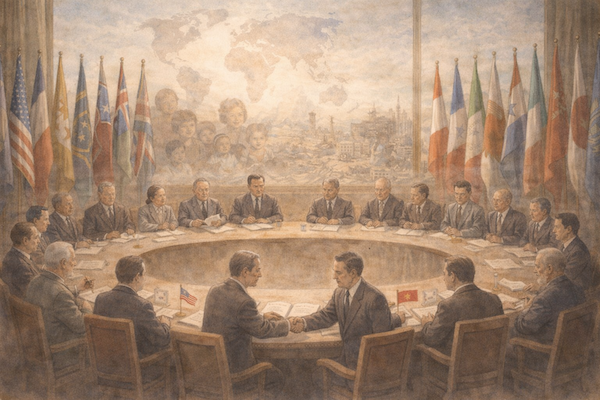
Editorial Team: The book also looks at information, treaties, and inventions. That felt distinctive.
Author: To live wisely in the modern world, it is important to look not only at visible events, but also at the information and forces behind them.
From as early as the time of The Art of War, intelligence and espionage have played important roles.
Even today, information warfare and influence over public opinion shape society and international relations.
I hope the book helps readers compare information, think critically, engage in dialogue, and make better choices.
Treaties and international organizations are also essential for understanding today’s world.
While we could not cover everything in detail, we included examples as entry points for further exploration.
Inventions and discoveries are equally important.
They have shaped daily life and transformed societies throughout history.
And when we look at the world today, there are still many children who do not have sufficient access to education.
Even things that may seem obvious to us are not always available to learn.
If such children encounter this book, I hope it can serve as a doorway—helping them discover how humanity has developed tools, ideas, and innovations over time.
This book does not explain every mechanism in detail.
Instead, it aims to introduce the existence and background of ideas, so that readers can become curious and continue learning on their own.
I hope it can serve as a small step toward learning for children around the world, so that no one is left behind.
Crafting the Book and Expanding Across Languages
Editorial Team: What were your main priorities in creating the book?
Author: Not oversimplifying the content.
The goal was to make complex ideas understandable without losing their meaning.
Editorial Team: The book is available in Japanese and English.
Author: Yes. Sharing the same content across languages has real value.
We also plan to expand into Spanish, German, French, and other languages.
Editorial Team: It could also support language learning.
Author: Yes. Comparing different language editions can support foreign language learning, both in classrooms and self-study.
Who Do You Hope Will Read This Book?
Editorial Team: Finally, who do you hope will read this book?
Author: Of course, I hope it reaches children who are just beginning to explore history.
But I also hope that adults who wish to revisit history with fresh eyes will pick it up.
In particular, I would be very glad if it reaches the children who will shape the future.
At the same time, I hope it remains a book that is open to everyone—from children to adults.
If humanity is to cooperate and build a more livable and hopeful future, I believe it is important that people are able to look at the same things, talk with one another, and think together.
I hope this book can serve as one small step toward that.
I would be glad if it becomes a book that people can use in different ways—reading it together as a family, using it as a starting point for conversation, and returning to it over time.
Closing Thoughts
The Story of Humankind is not only about the past, but also about how we think and live in the future.
By exploring history, inventions, information, and global connections, readers can develop the ability to think more deeply and make better choices.
Children and adults can share the same book and the same conversation.
And perhaps those small moments can help shape the future.
I also hope that, regardless of where they live or what opportunities they have, children everywhere can discover the joy of learning through this book.
Book Information
The Story of Humankind is available in both Japanese and English, in paperback and ebook formats.
Please explore the links above for details and purchase options.